Managed STUN and TURN
Managed STUN and TURN is available directly from rstream tunnels.
If a tunnel project already publishes the signaling API or WebSocket endpoint for a WebRTC application, the same project can issue TURN credentials and use the hosted relay service for ICE fallback. That removes the usual split between publishing signaling and operating a separate STUN/TURN stack.
The hosted service accepts STUN binding requests over UDP and TCP on IPv4 and IPv6. TURN UDP relay allocations are available over UDP, TCP, TLS, and DTLS on IPv4 and IPv6. TURN TCP relay allocations are currently available over TCP and TLS on IPv6.
You can issue TURN credentials through the platform API, through the Go SDK, or through local derivation inside an existing backend.
Managed STUN and TURN is included on hosted plans at no additional cost. Relay usage is metered independently from regular rstream tunnels bandwidth; quota varies by plan. Community Edition deployments do not include managed STUN/TURN.
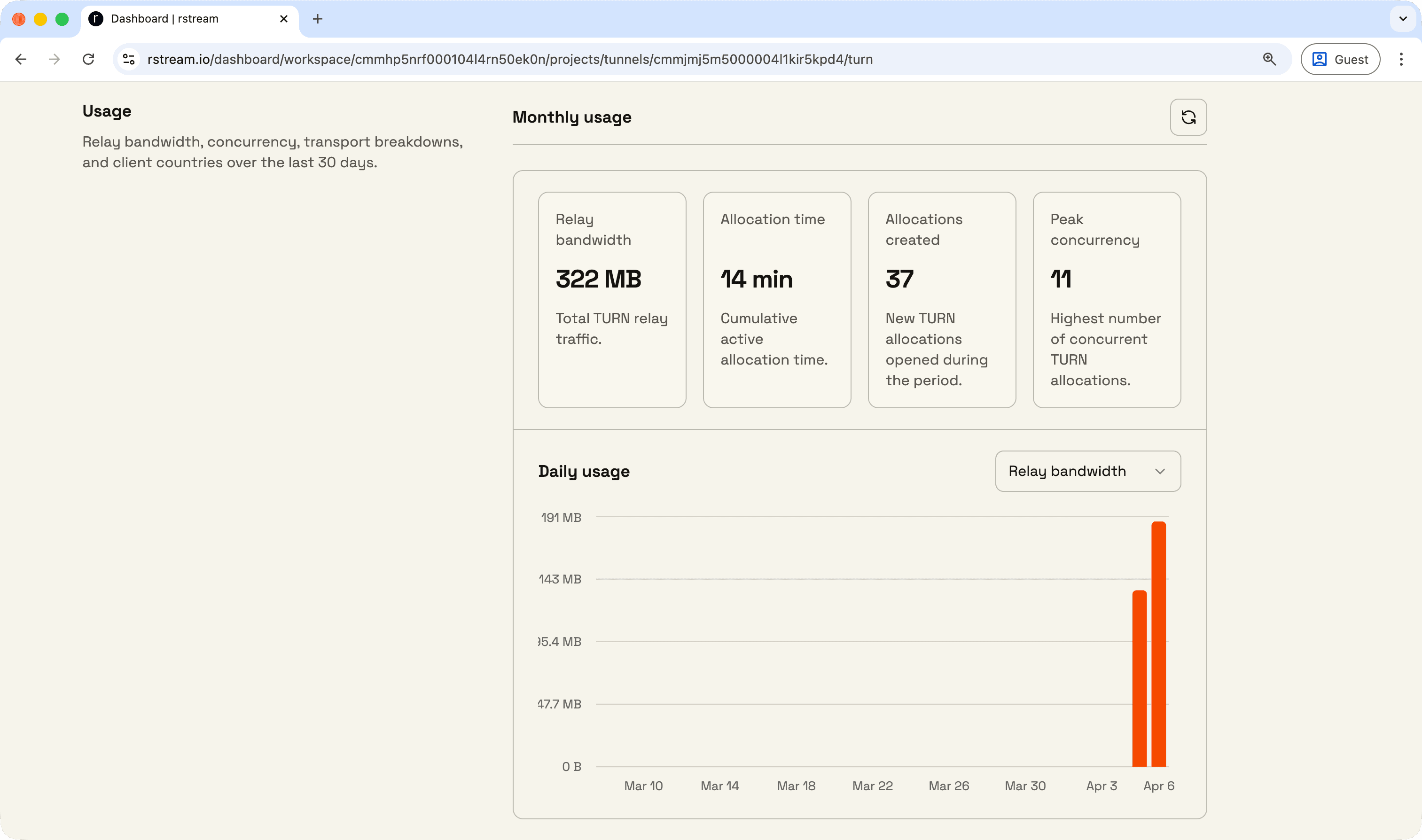
The dashboard now surfaces TURN alongside the existing tunnel views. The project usage page keeps TURN bandwidth separate for the current billing period, and the dedicated TURN page adds connection details, credential issuance, monthly usage, and 30-day operational breakdowns for relay traffic, concurrency, transports, allocation types, address families, and client countries.
For protocol details, issuance flows, hosted limits, and dashboard behavior, refer to STUN and TURN.
References: